Are you tired of endless scrubbing and mediocre car washes? We understand the struggle of achieving that showroom shine without the right tools. A foam cannon for pressure washer can revolutionize your detailing routine, transforming a chore into a satisfying experience.
We’ve delved deep into the world of automotive detailing to bring you an honest look at these powerful accessories. Join us as we explore how a quality foam cannon can elevate your car care, making every wash more effective and enjoyable.
Why Use a Foam Cannon for Pressure Washer?
If you are like us, you take immense pride in the way your vehicle looks when it pulls out of the driveway.
The traditional two-bucket method has been the gold standard for years, but it often carries a hidden risk for your paint.
When you scrub a dirty car with a mitt, you are essentially grinding abrasive particles directly into the clear coat.
This is where the foam cannon becomes your best friend and a true “must-have” in your detailing arsenal.
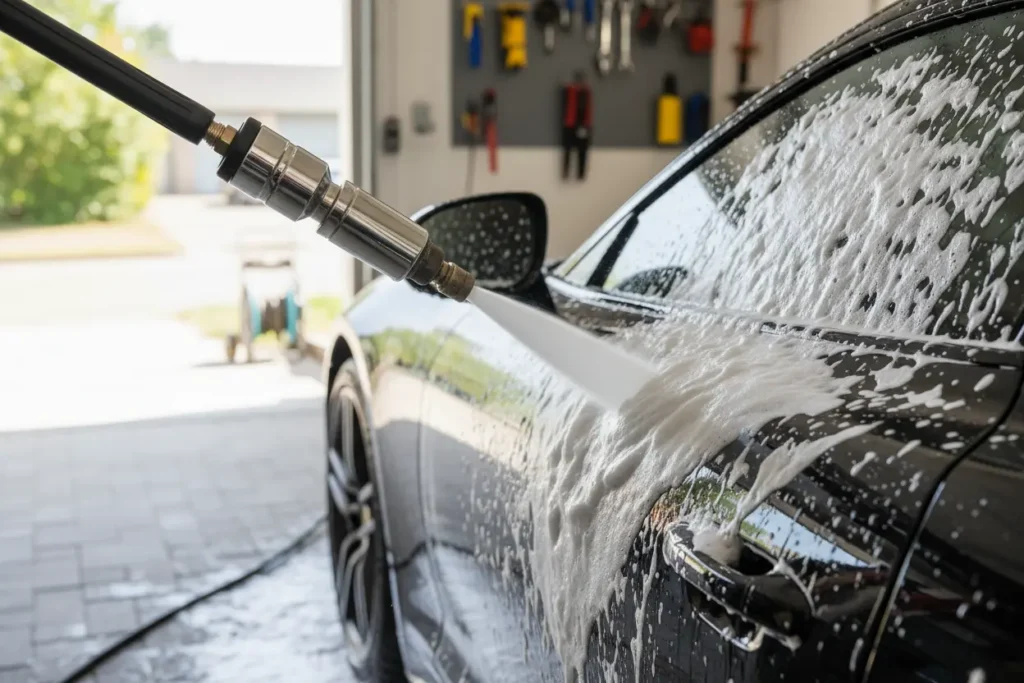
By using a foam cannon, we create a thick blanket of lubrication that sits on the surface of the car.
This foam works to encapsulate dirt, lifting it away from the paint before you ever touch the vehicle with a wash mitt.
It significantly reduces the chances of creating swirl marks and micro-scratches, which are every car enthusiast’s worst nightmare.
Beyond the safety aspect, there is no denying that using a foam cannon makes the washing experience incredibly enjoyable.
There is a certain satisfaction in seeing your car completely covered in “snow” that looks professional and smells great.
It also saves time by allowing the chemicals to do the heavy lifting, loosening road grime while you prep your wheels.
In our experience, once you go foam, you never go back to just a standard hose and bucket setup.
How a Foam Cannon Works: The Science of Suds

To the untrained eye, it looks like a simple bottle, but the internal mechanics are quite sophisticated.
A foam cannon operates on the Venturi effect, a principle of fluid dynamics that we find fascinating.
As high-pressure water from your machine passes through the cannon’s internal nozzle, it creates a vacuum.
This vacuum draws the concentrated car soap up from the bottle and mixes it with the rushing water stream.
The mixture then passes through a stainless steel mesh filter, which is where the real “magic” happens.
As the water and soap mixture is forced through this mesh at high speed, it agitates the solution and injects air.
This process, known as aeration, turns a simple liquid into the thick, shaving-cream-like foam we all love.
Most high-quality cannons feature an adjustable orifice, which dictates how much water passes through the system.
If you use a lower-powered electric pressure washer, a smaller orifice (1.1mm) is often necessary to maintain pressure.
We always recommend checking your GPM (Gallons Per Minute) to ensure your cannon is tuned for your specific machine.
The top knob on the cannon allows you to control the soap-to-water ratio, letting you dial in the thickness.
Meanwhile, the front nozzle adjusts the spray pattern, from a narrow stream to a wide, sweeping fan of suds.
Key Features to Look for in a Foam Cannon
When you start shopping, you will notice prices ranging from twenty dollars to over a hundred.
The difference usually lies in the build quality and the materials used in the internal components.
We always suggest looking for a cannon with a heavy-duty brass body rather than cheap aluminum or plastic.
Brass is resistant to corrosion and wear, ensuring your investment lasts through hundreds of washes.
The bottle design is another factor that many people overlook until they actually start using the tool.
Look for a bottle with a wide base so that it doesn’t tip over when you set it on the ground.
A wide-mouth opening is also a lifesaver, making it much easier to pour in soap without spilling it everywhere.
Capacity is generally standard at 1 liter, which is more than enough to cover a large SUV or truck.
Check for clear measurement markings on the side of the bottle to help you get your dilution ratios perfect every time.
Compatibility is the final “make or break” feature you must verify before clicking the buy button.
Most foam cannons come with a 1/4-inch quick-connect fitting, which is the standard for most pressure washer wands.
However, if you own a proprietary brand like Karcher or Sun Joe, you might need a specific adapter.
Lastly, look for a unit that offers a fully adjustable spray nozzle to give you total control over the fan width.
Top Foam Cannons for Pressure Washers Reviewed
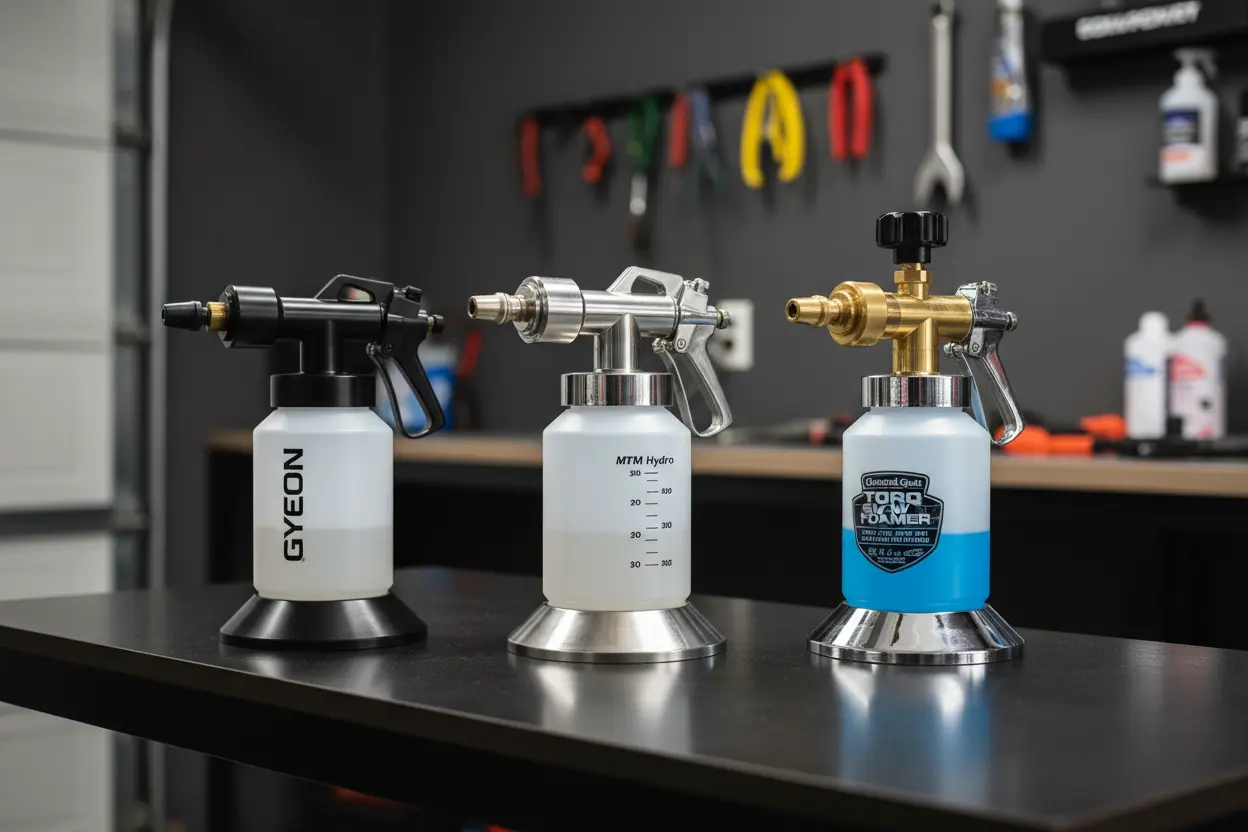
We have tested several models to see which ones actually deliver on their promise of thick suds.
Below is a comparison of the top contenders currently dominating the automotive detailing market.
| Model | Material | Best For | Key Pro |
|---|---|---|---|
| MTM Hydro PF22.2 | Italian Brass | Professionals | Incredible foam quality |
| Griots Garage Boss | Heavy Duty Plastic | Enthusiasts | Easy-to-use metering |
| Tool Daily Cannon | Standard Brass | Budget Buyers | Unbeatable price point |
| Chemical Guys Big Mouth | Reinforced Plastic | Beginners | Very easy to fill |
The MTM Hydro PF22.2 is widely considered the “Gold Standard” in the detailing community for a reason.
It features a patented nozzle that allows you to spray both vertically and horizontally with a simple twist.
The build quality is industrial grade, meaning it can handle daily use without losing performance.
For those on a budget, the Tool Daily model is a surprising overachiever that performs well above its price.
It may not have the finesse of the higher-end models, but it produces great foam for a fraction of the cost.
We found that the Griots Garage Boss system is excellent because it integrates with their specific soap bottles.
This “plug and play” approach removes the guesswork of mixing and measuring, which we find very convenient.
If you have a lower PSI electric washer, make sure to swap the internal orifice for a 1.1mm version.
This small upgrade can turn a mediocre cannon into a foam-producing beast, regardless of the brand.
Best Soaps for Your Foam Cannon
Not all car soaps are created equal, and using the wrong one will lead to disappointing results.
To get those clinging suds, you need a soap specifically formulated for high-foaming applications.
These soaps contain surfactants that are designed to stay stable when aerated by the pressure washer.
We highly recommend using a pH-neutral soap for your regular maintenance washes.
A pH-neutral formula will clean the dirt without stripping away your wax, sealant, or ceramic coating.
If you are preparing for a full detail, you might want a “strip wash” soap to remove old protection.
Look for products labeled as “Snow Foam” as these are optimized for the longest dwell time on the paint.
The longer the foam stays on the car, the more time it has to break down road film and contaminants.
| Soap Type | Recommended Use | Key Benefit |
|---|---|---|
| pH Neutral | Weekly Maintenance | Safe for all coatings |
| High Alkaline | Heavy Decontamination | Strips old waxes easily |
| Ceramic Infused | Added Protection | Leaves a hydrophobic layer |
We have found that Chemical Guys Mr. Pink and Honeydew Snow Foam are fantastic starting points for beginners.
For those who want the absolute thickest foam possible, Adams Polishes Mega Foam is a top-tier choice.
Always remember that more soap doesn’t always mean better cleaning; it’s about the quality of the formula.
Avoid using dish soap, as it is too harsh and will dry out your rubber seals and plastic trim over time.
Setting Up and Using Your Foam Cannon
Setting up your foam cannon for the first time is a straightforward process, but precision matters.
Start by filling your bottle with warm water first, rather than the soap itself.
Adding water first prevents the soap from sudsing up prematurely while you are trying to fill the container.
We generally recommend a dilution ratio of 1 part soap to 10 parts water for most concentrated formulas.
Once filled, attach the suction tube to the brass head and screw the bottle on firmly but do not over-tighten.
Give the bottle a gentle shake to ensure the soap and water are thoroughly mixed before attaching it.
Connect the cannon to your pressure washer wand and ensure the quick-connect collar clicks into place.
Before spraying the car, point the nozzle at the ground and adjust the top knob to the maximum soap setting.
Once you see thick foam emerging, adjust the fan blades to your desired spray width.
We recommend applying the foam from the bottom of the car to the top.
This ensures the soap has the maximum dwell time on the dirtiest parts of the vehicle, like the rocker panels.
Let the foam sit for 3-5 minutes, but never allow it to dry on the paint, especially in direct sunlight.
Finally, rinse the car thoroughly from top to bottom to wash away the encapsulated dirt and grime.
Maintenance Tips for Longevity
A foam cannon is a precision tool, and neglecting maintenance will lead to a quick decline in performance.
The most common issue users face is a clogged mesh filter, usually caused by dried soap residue.
To prevent this, you should flush the system after every single car wash session you perform.
Simply remove the soap bottle, rinse it out, and fill it with clean, fresh water.
Attach the bottle back to the cannon and spray the clear water through the nozzle for 60 seconds.
This clears out any residual soap from the internal mesh and the orifice, preventing “calcification.”
We also suggest periodically checking the O-rings on the quick-connect fitting for any signs of cracking.
A small amount of silicone grease on these rings will keep the connection smooth and leak-free.
If your foam starts looking “watery,” it is likely time to replace the internal mesh filter.
These filters are inexpensive and can be swapped out with basic tools in about ten minutes.
Store your foam cannon in a cool, dry place away from direct sunlight to protect the plastic bottle.
If you live in an area with hard water, consider using distilled water in your soap mix to prevent scale buildup.
Common Mistakes to Avoid with Foam Cannons
Even experienced detailers can fall into bad habits that ruin the foam cannon experience.
The biggest mistake we see is using too much soap in the bottle, thinking it will create “better” foam.
Excessive soap actually makes the mixture too thick to travel through the orifice efficiently, causing sputtering.
Another frequent error is spraying onto a hot surface or in direct, punishing sunlight.
If the foam dries on the paint, it can leave unsightly spots that are difficult to remove without polishing.
Always work on a cool-to-the-touch surface and in the shade whenever it is possible to do so.
We often see people forgetting to rinse the cannon, which leads to the dreaded “clogged filter” syndrome.
Don’t make the mistake of using a high-pressure orifice with a low-pressure electric machine.
If your pressure washer is under 2000 PSI, you must use a 1.1mm orifice to get professional results.
Finally, never use the foam cannon as a replacement for a mechanical wash if the car is heavily soiled.
The foam is a pre-wash step; for a truly clean car, you still need a gentle contact wash afterward.
By avoiding these pitfalls, you ensure a perfect finish and a tool that lasts for years to come.
Elevate Your Car Wash Game Today!
We’ve explored the incredible potential a quality foam cannon brings to your car detailing. From superior cleaning power to a truly satisfying experience, it’s an investment that pays off in dazzling results and saved effort. We believe every car enthusiast deserves this upgrade.
Ready to transform your car washing routine? Share your favorite foam cannon tips in the comments below, or tell us which model you’re excited to try next! Let’s keep our rides sparkling!
FAQ – Common Questions About Foam Cannons
We’ve compiled the most frequent questions we receive to help you get the most out of your setup and ensure a swirl-free shine every time.
1. Do I need a specific type of pressure washer to use a foam cannon?
Most units we’ve tested work with both gas and electric models, provided they meet the minimum PSI and GPM requirements. I recommend checking that your machine has a 1/4-inch quick-connect fitting, which is the standard for most foam cannons on the market.
2. Can I use regular dish soap instead of dedicated car wash soap?
We strongly advise against this, as dish soap is designed to strip grease and will likely remove your car’s protective wax or sealant. For the best results in any foam cannon for pressure washer review, always use a pH-balanced, high-foaming soap specifically formulated for automotive use.
3. Why is my foam cannon producing watery suds instead of thick foam?
This usually happens if the soap-to-water dilution ratio is too low or if your pressure washer’s GPM (Gallons Per Minute) is insufficient. I suggest adjusting the top intake knob toward the “minus” sign to increase the soap concentration and ensure your foam cannon for pressure washer is properly tightened.
4. How do I prevent my foam cannon from clogging over time?
The best way to maintain your equipment is to run clean, warm water through the cannon for about 30 seconds after you finish washing. This simple step flushes out leftover soap residue that would otherwise dry and clog the internal stainless-steel mesh filter.
5. Is a foam cannon really worth the investment for a casual hobbyist?
Absolutely, because it provides a thick layer of lubrication that helps prevent swirl marks and scratches during the wash process. We believe the time saved and the added protection for your vehicle’s paint make it an essential tool for any car enthusiast.