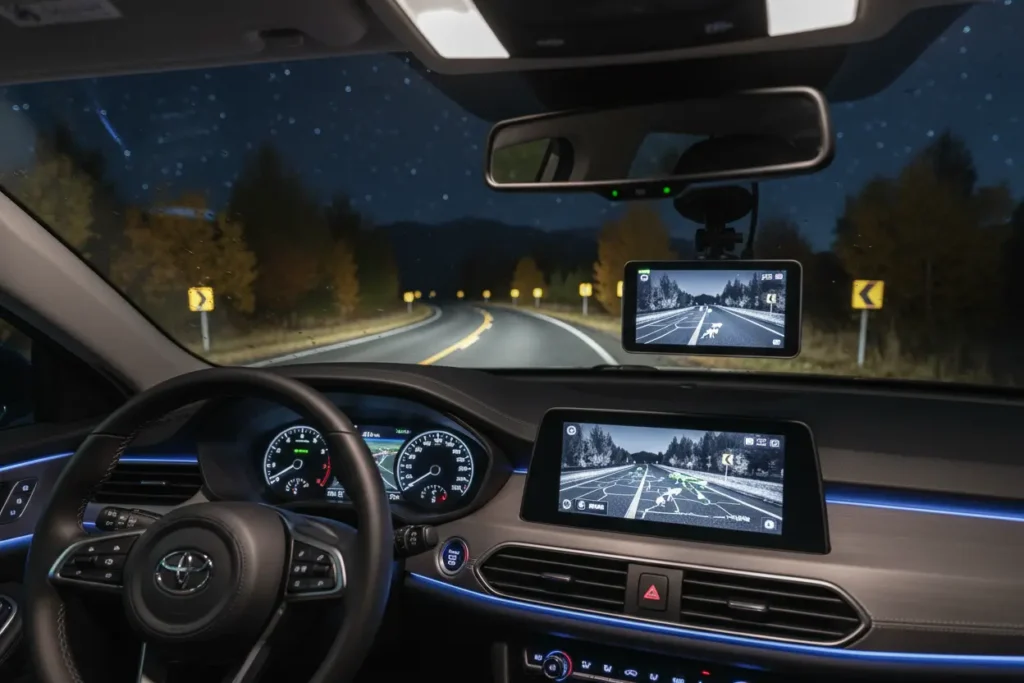
Driving at night presents unique challenges, from reduced visibility to unexpected hazards. A reliable dash cam isn’t just an accessory; it’s your silent witness, capturing crucial details when you need them most. But how do you choose one that truly excels in the dark?
We understand the importance of clear, crisp footage, especially after sunset. That’s why we’ve delved deep into the world of automotive tech to bring you an honest, detailed look at the best dash cams for night driving, ensuring you make an informed decision for your safety and peace of mind.
Why Night Vision Matters in Dash Cams
Driving at night introduces a completely different set of visual challenges compared to daytime cruising.
I have often said that a dash cam is only as good as its worst recording.
In the dark, standard cameras often struggle to differentiate between a dark road and a shadowy figure.
We face the constant issue of glare from oncoming headlights, which can completely “blind” a basic sensor.
Standard dash cams often produce grainy, pixelated footage when the sun goes down, rendering them useless for evidence.
Without specialized night vision, license plates become blurry white rectangles under the reflection of your own lights.
We believe that clarity in low light is the most critical feature for any serious driver today.
Nighttime is when many hit-and-runs and high-speed incidents occur, making clear documentation absolutely vital.
If you can’t see the make, model, or plate of a vehicle, your “evidence” is just a story.
Specialized night vision features are designed to balance exposure, ensuring that shadows aren’t too dark and lights aren’t too bright.
We have tested dozens of units, and the difference between a budget camera and a night-optimized one is staggering.
Investing in a camera that masters the dark is about peace of mind during those late-night commutes.
Key Features for Superior Night Driving Dash Cams
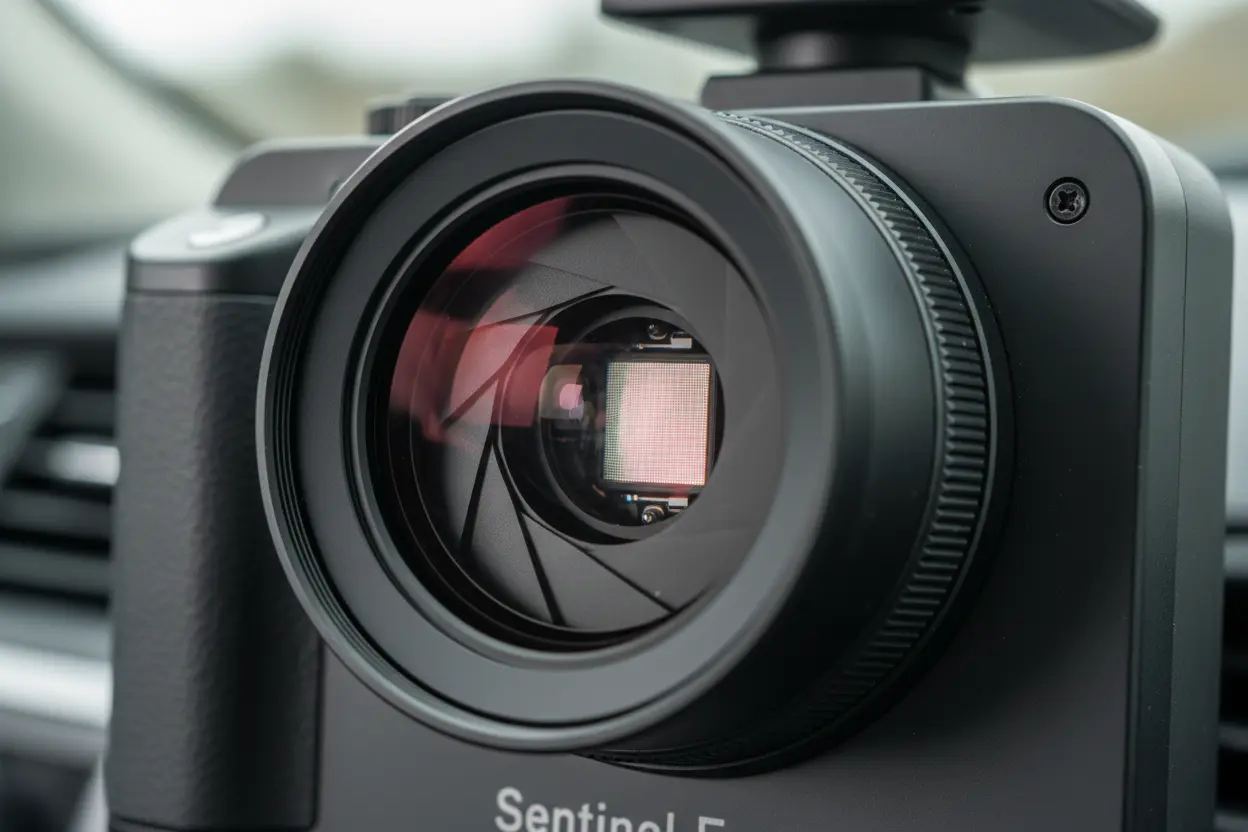
To get the best results, we must look at the hardware hidden inside the sleek plastic casing.
The first thing I check is the aperture size, usually denoted as an “f-number” like f/1.8 or f/1.6.
A lower number means a larger opening, allowing more light to hit the sensor during those dark hours.
Think of it like a window; the wider it is, the more natural light floods into the room.
Next, we need to talk about the image sensor, which is the “eye” of your dash cam.
We highly recommend looking for the Sony STARVIS or STARVIS 2 sensors, as they are the industry gold standard.
These sensors are specifically engineered to capture vibrant details in near-total darkness, far surpassing human vision.
OmniVision also produces excellent sensors that handle dynamic range exceptionally well in urban night environments.
WDR (Wide Dynamic Range) and HDR (High Dynamic Range) are technologies that balance the lighting in a frame.
They prevent the “white-out” effect when a bright headlight hits your lens directly in a dark alley.
By combining multiple exposures, these features ensure that shadows stay visible while highlights remain crisp and clear.
Finally, a powerful processor is needed to stitch all this data together in real-time without lagging or crashing.
| Feature | Importance for Night | Recommendation |
|---|---|---|
| Aperture | Light intake | f/1.8 or lower |
| Sensor | Low-light sensitivity | Sony STARVIS 2 |
| HDR/WDR | Glare reduction | Essential |
| IR Lights | Interior monitoring | Required for Cabin |
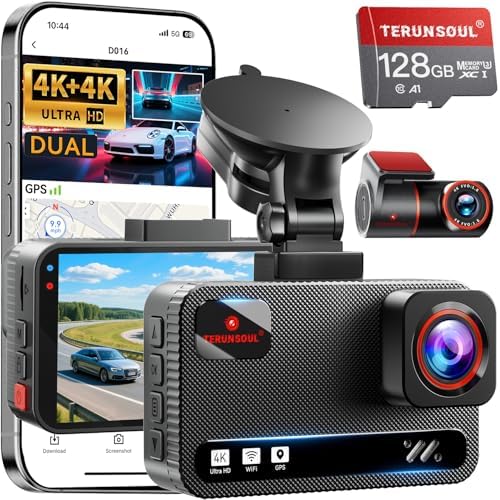
- Ultra HD 4K Front + 4K Rear Recording: The Terunsoul dash cam supports dual-channel simultaneous recording, capturing bo…
- Loop Recording & G-Sensor: The dash cam front and rear comes with a pre-installed 128GB memory card, ready to record ins…
- Super Starlight Night Vision: Enhanced WDR and sharper night vision technology deliver vibrant colors and clear details …
Top Contenders! Best Dash Cams for Night Driving
After extensive road testing, we have narrowed down the best dash cams for night performance.
The Vantrue N4 Pro is currently one of our top picks for overall nighttime clarity.
It utilizes the Sony STARVIS 2 sensor, which provides incredible resolution even on unlit country roads.
Pros: Stunning 4K quality, excellent HDR, and a three-channel system to cover the front, rear, and cabin.
Cons: It is a bit bulkier than other models and sits at a premium price point.
Next, we have the VIOFO A229 Pro, which is a favorite among the enthusiast community for its reliability.
I love its dual-channel STARVIS 2 setup, ensuring the rear camera is just as capable as the front.
Pros: Exceptional license plate readability at night and a very user-friendly interface.
Cons: The app connectivity can sometimes be a bit slow when downloading large 4K files.
For those who want a “set it and forget it” experience, the Thinkware U3000 is an absolute powerhouse.
It features Super Night Vision 4.0, which uses AI-based processing to brighten dark scenes without adding noise.
Pros: Best-in-class parking mode and extremely low power consumption for long-term monitoring.
Cons: The initial setup and professional installation are highly recommended due to its advanced features.
We also suggest looking at the 70mai Dash Cam A810 for a more budget-friendly night vision option.
It still offers 4K resolution and decent low-light performance thanks to its optimized software algorithms.
Pros: Very affordable for the specs provided and a compact, discreet design.
Cons: The night footage, while good, isn’t quite as sharp as the Sony-powered Vantrue or VIOFO models.
Installation Tips for Optimal Night Footage
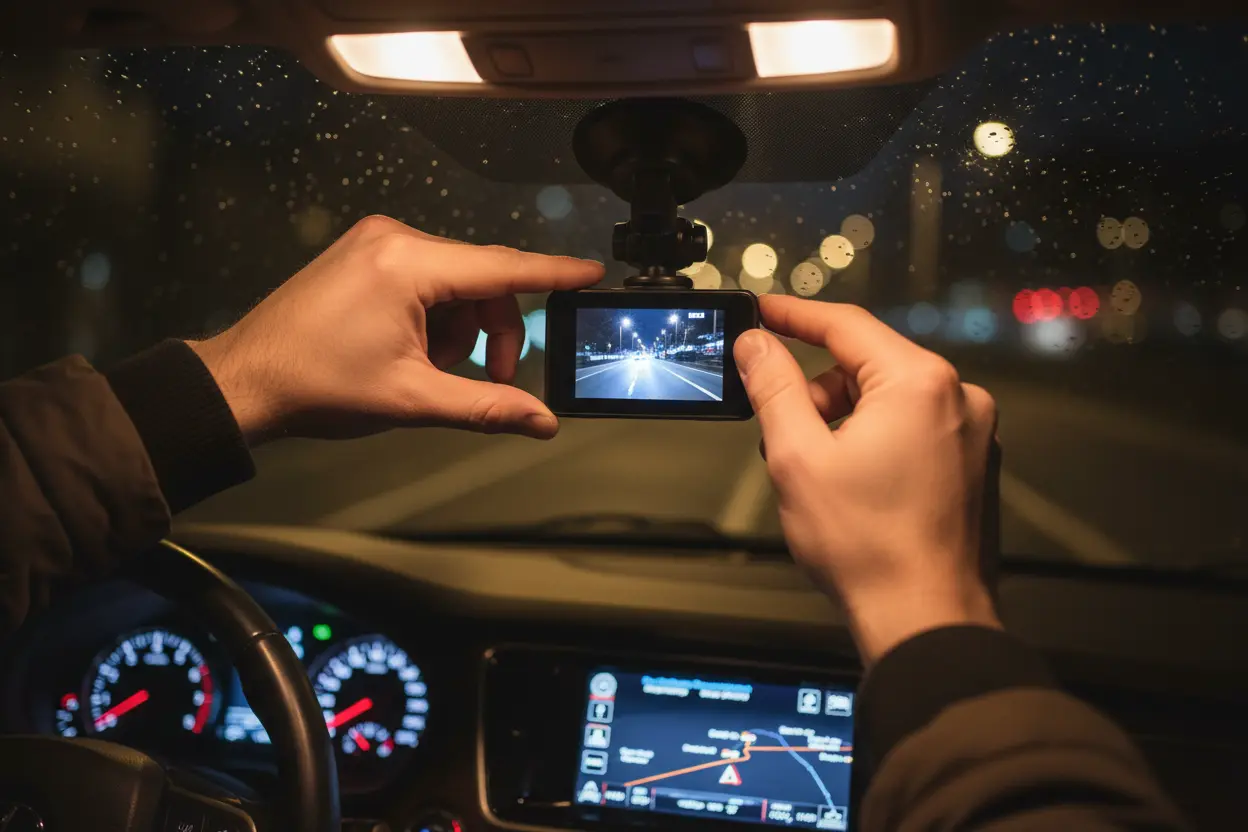
Proper installation is the secret sauce to getting professional-grade night footage from your device.
I always recommend placing the camera directly behind the rearview mirror to minimize distractions.
This central position provides a symmetrical view of the road, capturing both sides of the lane equally.
Ensure the lens is not blocked by the tinted strip at the top of your windshield.
We often see drivers tilt their cameras too high, capturing too much of the bright sky or streetlights.
Angling the lens slightly downward ensures the camera focuses on the road and vehicle hoods.
This helps the auto-exposure sensors calibrate for the darker pavement rather than the bright moon or lights.
Cable management is also crucial; use the included clips to tuck wires into the headliner and pillars.
Loose wires can create reflections on the glass at night, which might obscure important details in your video.
I highly suggest using a CPL (Circular Polarizing Lens) filter if your camera supports it.
A CPL filter acts like sunglasses for your dash cam, significantly reducing dashboard glare on the windshield.
At night, this filter helps eliminate the distracting reflections of your own interior lights or dashboard electronics.
Finally, keep your windshield spotless; even a tiny smudge can catch light and create a massive blur at night.
Understanding Video Quality and File Formats
When we talk about video quality, resolution is usually the first thing people mention.
While 4K (2160p) offers the most detail, it requires a lot of processing power and storage space.
1440p (QHD) is often a “sweet spot” for night driving, offering great clarity without excessive file sizes.
However, frame rate (FPS) is just as important as resolution when you are in motion.
We recommend 30fps for night driving because it allows for a longer shutter speed per frame.
A longer shutter speed lets in more light, which is exactly what you need in dark conditions.
While 60fps looks smoother, it can sometimes result in darker, noisier footage when there isn’t enough ambient light.
The video codec (like H.264 or H.265) determines how the footage is compressed and stored.
H.265 (HEVC) is superior because it keeps the quality high while making the files much smaller.
This is vital for license plate readability, as it preserves the fine details that compression often destroys.
If you are involved in an accident, you need that raw detail to prove your case to the insurance company.
I always tell my readers: don’t just look at the advertised resolution; look at the bit-rate and sensor tech.
A high-quality 1080p camera with a great sensor will always beat a cheap “4K” camera with a poor sensor.

- 4K FRONT + 1080P REAR RECORDING – ROVE R2-4K DUAL dash cam offers dual-channel recording capabilities, capturing footage…
- SONY STARVIS 2 SENSOR/SUPER NIGHT VISION – Equipped with a Sony IMX675 STARVIS 2 Image Sensor for the front camera, this…
- ULTRA FAST 5G WIFI/ UP TO 20MB/s DOWNLOAD SPEED – With its built-in dual-band 5GHz and 2.4GHz WiFi, you can use the ROVE…
Legal Aspects and Data Storage Considerations
Before you hit the road, we must discuss the legalities of using a dash cam in the US.
In most states, dash cams are perfectly legal, but mounting locations can be strictly regulated.
For example, in California and Maryland, there are specific rules about how much of the windshield can be covered.
We always advise checking your local state laws to ensure your camera doesn’t obstruct your field of view.
Regarding audio recording, some states are “two-party consent” states, meaning you might need to inform passengers.
Now, let’s talk about storage, which is often the most overlooked part of the setup.
Night footage, especially in high resolution, creates massive files that require fast, durable memory cards.
We strictly recommend using “High Endurance” microSD cards designed for constant overwrite cycles.
Standard cards will likely fail within months due to the intense heat and constant writing of a dash cam.
Look for a Class 10, U3, or V30 rating to ensure the card can keep up with 4K data streams.
Loop recording is a standard feature that overwrites the oldest files when the card is full.
However, we suggest a card with at least 128GB or 256GB so you have several hours of footage before it loops.
Many modern cameras also offer Cloud storage options, which automatically upload “event” clips to the internet.
This is a fantastic backup in case the camera itself is stolen or damaged during a serious collision.
We believe that having a reliable storage strategy is just as important as the camera you choose to buy.
Your Night Vision, Our Priority
Choosing the best dash cam for night driving is an investment in your safety and peace of mind. We hope this guide has illuminated the path, equipping you with the knowledge to select a device that truly performs when the sun goes down. Drive with confidence, knowing you’re protected.
What’s your experience with night driving dash cams? Share your thoughts, questions, or favorite models in the comments below! Your insights help our community navigate the road ahead.
FAQ – Common Questions About the Best Dash Cam for Night Driving
We’ve compiled the most frequent questions from our community to help you choose and maintain the best dash cam for night driving for your vehicle.
Not necessarily. While 4K provides more detail, the best dash cam for night driving relies more on a high-quality sensor (like Sony STARVIS) and a wide aperture to pull in more light. A 1080p camera with superior low-light technology often outperforms a cheap 4K camera once the sun goes down.
To combat glare, we recommend choosing a camera equipped with WDR (Wide Dynamic Range) or HDR technology. These features automatically balance the bright lights from oncoming traffic and dark shadows, ensuring that license plates remain readable rather than being “washed out” by light.
Yes, because night footage captured by the best dash cam for night driving often uses higher bitrates to maintain clarity. We always suggest using a High Endurance U3-rated microSD card to handle the constant rewriting and large file sizes without failing during a critical moment.
Absolutely! For the best results, we suggest mounting the camera in the center of the windshield, high up behind the rearview mirror, to minimize reflections from the dashboard. Ensure your windshield is clean inside and out, as streaks can cause significant light blooming and blurriness at night.
Infrared lights are excellent for capturing the interior of the cabin in total darkness, which is why we recommend them for rideshare drivers. However, for recording the road ahead, high-end sensors and advanced image processing are much more effective than IR LEDs at illuminating distant objects.