We all want our cars to look their best, protected from the elements and shining like new. With many paint protection options, choosing the right one is tough. Today, we’re diving deep into ceramic coating kits for cars to help you make an informed decision.
I’ve tested popular kits to bring you an honest look at their application, durability, and overall value. Join us as we explore if these DIY solutions deliver professional results and are the right investment for your vehicle.
What is Ceramic Coating and How It Works
When we talk about ceramic coating, we are referring to a liquid polymer that chemically bonds with your vehicle’s factory paint.
Unlike a traditional wax that sits on the surface, this coating creates a semi-permanent layer of protection that doesn’t wash off.
At its core, most high-quality kits use Silicon Dioxide (SiO2), often derived from quartz or sand, to create a glass-like finish.
We find that the primary benefit is extreme hydrophobicity, meaning water and contaminants bead up and slide off effortlessly.
This “self-cleaning” effect ensures that road grime, bird droppings, and tree sap have a harder time sticking to your clear coat.
Beyond the beads, these coatings provide vital UV protection, preventing your paint from oxidizing or fading under the harsh sun.
While many claim “scratch resistance,” we must be honest: it protects against micro-marring, not deep scratches or rock chips.
The main difference between this and a standard wax is durability; a wax lasts weeks, while a coating lasts years.
Think of it as a sacrificial barrier that takes the brunt of environmental abuse so your original paint doesn’t have to.
We believe understanding this science is the first step toward deciding if the DIY investment is right for your garage.
Top Ceramic Coating Kits for Cars Reviewed
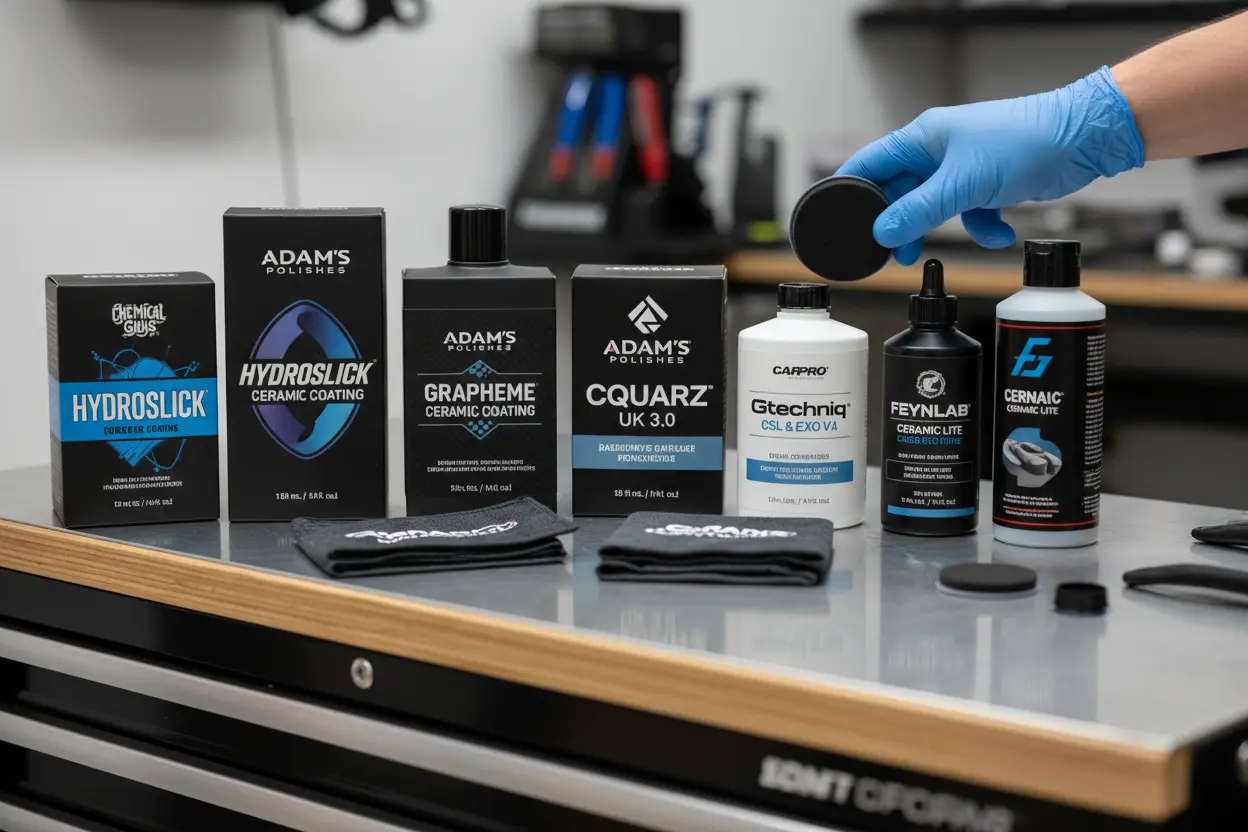
Selecting the right kit can be overwhelming, so we have tested the most reputable options currently dominating the US market.
First on our list is Adam’s Graphene Ceramic Coating, which has revolutionized the DIY space with its Graphene infusion.
The standout feature here is the UV Tracer Technology, which allows you to see exactly where the product is applied using a blacklight.
We found this incredibly helpful for beginners to ensure 100% coverage without leaving any dangerous “high spots” behind.
Next, we looked at Meguiar’s Hybrid Ceramic Wax, which is the perfect entry point for those intimidated by professional-grade liquids.
It offers a “spray-on, rinse-off” application that delivers surprising gloss and water beading for a fraction of the effort.
While it won’t last as long as a true coating, it provides an excellent cost-benefit ratio for the casual enthusiast.
For the purists, CarPro CQuartz UK 3.0 remains our top recommendation for achieving that signature “deep-wet” look.
It is specifically formulated for colder climates, making the flashing and wiping process much more predictable for the home detailer.
| Product Name | Difficulty Level | Durability | Best For |
|---|---|---|---|
| Adam’s Graphene | Moderate | 7+ Years | Longevity & Precision |
| Meguiar’s Hybrid | Easy | 3-6 Months | Speed & Value |
| CarPro CQuartz | Moderate/High | 2+ Years | Maximum Gloss |

- ADVANCE CERAMIC COATING: An improved CQUARTZ formula that provides resistance to chemicals, salt, and environmental dama…
- IMPROVED TEMPERATURE APPLICATION: Recommended application ranges from 40F to 100F with recommended surfaces such as Pain…
- PROFESSIONAL COATING: CQUARTZ UK has 70% SiO2 with 99.9% purity. This extremely high SiO2 level gives superior protectio…
Each of these kits includes the basics, but we always suggest having extra high-quality microfiber towels on hand.
The Adam’s kit usually comes with the applicator and the light, making it the most comprehensive “all-in-one” package we’ve used.
If you want the absolute best protection, go with Adam’s or CarPro; if you want a quick boost, Meguiar’s is your winner.
Essential Steps for Ceramic Coating Application
The secret to a flawless ceramic finish isn’t in the bottle; it is entirely in the surface preparation work you do.
We cannot stress this enough: if you coat over a swirl mark or a speck of dirt, you are locking it in for years.
The process begins with a thorough strip wash using a high-pH soap to remove all old waxes and sealants from the paint.
Next, we perform mechanical decontamination using a clay bar to pull embedded iron and grit out of the pores of the paint.
Following the clay, we highly recommend a light paint correction or polish to ensure the surface is as smooth as possible.
Once the paint is perfect, you must use an IPA (Isopropyl Alcohol) wipe-down to remove any remaining polishing oils.
This step is crucial because the coating needs a completely bare surface to create a proper chemical bond.
When applying the liquid, we use a cross-hatch pattern (up-and-down, then side-to-side) to ensure even distribution.
Watch for the “flash”—when the coating begins to look like oil slicks or beads up—before gently buffing it off.
One of the biggest mistakes we see is working in direct sunlight, which causes the coating to flash too quickly and streak.
Always work in a controlled environment, like a garage, and allow the car to cure for at least 24 hours away from moisture.
Avoiding water during the initial curing phase is the difference between a coating that lasts and one that fails in a month.
Maximizing Durability and Long-Term Care
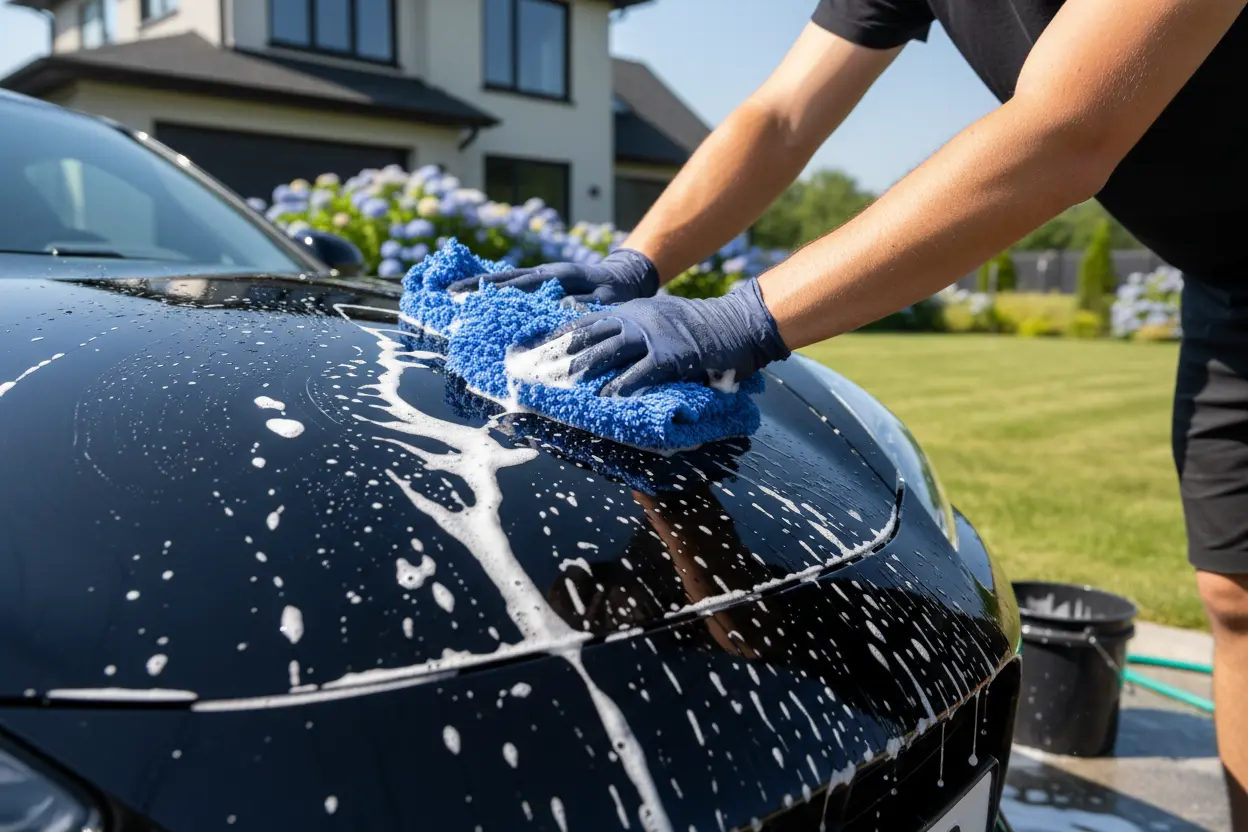
Once your car is coated, the work doesn’t stop; you need a maintenance routine to keep that hydrophobic effect alive.
We strongly advise against using automatic car washes with abrasive brushes, as they will eventually degrade the coating’s surface.
Instead, we utilize the two-bucket wash method with a dedicated grit guard to prevent scratching during the cleaning process.
Always use a pH-neutral car shampoo that does not contain added waxes or silicones, which can “clog” the ceramic layer.
To maintain the “slickness,” we recommend applying a ceramic booster spray or “topper” every three to four months.
These products contain a small amount of SiO2 that fills in microscopic gaps and refreshes the water-beading performance.
If you notice the water is no longer beading, it usually means the surface is contaminated, not that the coating is gone.
A quick decontamination wash with an iron remover often brings the original properties of the coating back to life instantly.
We must have realistic expectations: a coating makes a car easier to clean, but it is not a “set it and forget it” solution.
Under harsh US winter conditions with heavy road salt, you may need to wash more frequently to prevent salt buildup.
By following these steps, we have seen DIY coatings easily exceed their rated lifespan, keeping cars looking showroom-fresh for years.
Investing the time in proper maintenance ensures that your hard work during the application phase truly pays off.

- ✅ PROTECT YOUR CAR LIKE NEVER BEFORE with Adam’s UV Graphene Ceramic Coating – a nanocrystalline shield that repels wate…
- ✅ NEVER MISS A SPOT AGAIN with Adam’s Patent-Pending UV Tracing Technology! Our Ceramic Glow Technology helps you apply …
- ✅ UNLEASH A DAZZLING SHINE with Adam’s Graphene Coating – the key to a mirror-like finish is in the preparation stage. A…


Your Car’s Future, Protected!
Investing in a ceramic coating kit for cars can truly transform your vehicle’s appearance and protection. We’ve explored the science, reviewed top products, and outlined the best application practices to help you achieve that coveted showroom shine and lasting defense against the elements.
Now that you’re armed with this knowledge, we encourage you to take the next step. Share your experiences in the comments below, or tell us which kit you’re excited to try! Let’s keep our cars looking incredible, together.
FAQ – Common Questions About Ceramic Coating Kits
We’ve compiled the most frequent questions we receive from fellow enthusiasts to help you decide if a DIY ceramic coating is right for your vehicle.
While it requires patience and attention to detail, most modern kits are designed specifically for DIY enthusiasts. If you follow our guide on proper surface preparation and curing times, you can achieve professional-looking results in your own garage.
Depending on the specific product and your local climate, a high-quality ceramic coating kit for cars typically lasts between two to five years. We’ve found that regular maintenance washes using pH-neutral soaps are essential to maximizing this lifespan.
No, you should avoid using traditional waxes over your coating, as they can interfere with the coating’s hydrophobic properties. Instead, we recommend using a dedicated ceramic booster or maintenance spray to enhance the shine and protection.
Ceramic coatings are protective layers, not fillers, so they will not remove or hide existing scratches or swirl marks. We always suggest performing a full paint correction before application to ensure you aren’t sealing imperfections under the coating.
If you enjoy working on your car, a DIY kit offers incredible value by providing professional-grade protection at a fraction of the cost. We believe the results are well worth the effort, provided you don’t skip the crucial cleaning and decontamination steps.